Showing posts with label Andhra cuisine. Show all posts

Monday, September 29, 2025

DRUMSTICK CURRY

DRUMSTICKS CURRY

I was recently reading an article which highlighted the health benefits of Drumsticks- so commonly available in all parts of India. Drumsticks are called Muringakkai in Tamil, Nuggekai in Kannada, Mulakkada in Telugu, Sahajan in Hindi, Shevga in Marathi and Mashingasaang in my mother tongue, Konkani. 

As they are so good for health- and very tasty too- in my house, we make dishes with drumsticks quite often. Interestingly, the leaves of the drumstick are also used in cooking. 

Elsewhere in this blog, you will find recipes for dishes made with Drumsticks, such as:-

Today's recipe is from Andhra Pradesh. It goes well with hot steamed rice as well as with rotis. I have adapted this from Drumsticks Curry in Hebbar's Kitchen. 

We enjoyed it with hot steamed rice! 


Ingredients:

  • Drumsticks, 2
  • Onion, 1
  • Tomatoes, medium-sized, 2
  • Mustard Seeds, 1 tsp
  • Cumin Seeds, 1 tsp
  • Asafoetida, (Hing), 1/8 tsp 
  • Curry Leaves, a few'
  • Ginger Garlic Paste, 1 tsp
  • Turmeric Powder, 1/2 tsp
  • Chilli Powder, 1 tsp
  • Coriander Powder, 1 tsp
  • Cumin Powder, 1/2 tsp
  • Garam Masala, 1 tsp
  • Salt, to taste
  • Oil, 2 tbsp
  • Coriander Leaves, 2 tbsp
To Be Roasted & Ground To A Paste:-
  • Groundnuts, 2 tbsp
  • Sesame, (Til),  2 tbsp
  • Copra/ Dry Coconut, 2 tbsp
  • Poppy Seeds, (Khus Khus) 2 tsp

Method:-

Wash and peel the drumsticks. Snip off the two ends. Cut the drumsticks into 1 and 1/2 " pieces
Finely chop the onion and coriander leaves
Chop the tomatoes

Firstly cook the drumstick pieces in adequate water adding a little salt till they get done 
(Keep in mind the drumsticks get cooked quite fast). Keep aside 

Dry roast the groundnuts in a thick bottomed kadhai till they get spotted
Add sesame seeds, copra, and poppy seeds and roast on medium heat till the sesame seeds splutter and the roasted ingredients become aromatic 
Remove the roasted ingredients to a plate and allow them to cool completely
Transfer to a mixer jar and grind on pulse mode till they get crushed
Add 1/2 cup of water and grind to a smooth paste. Keep aside

In the same kadhai, heat 2 tbsp oil and on medium heat add the mustard seeds, when they splutter add cumin seeds, and when they sizzle, add asafoetida and curry leaves and saute for a few seconds
To this add the finely chopped onion, ginger garlic paste and saute till the onion becomes translucent  and the raw smell of the ginger garlic paste goes

Lower the heat, add turmeric powder, chilli powder, coriander powder, cumin powder, Garam Masala powder and salt to taste. Mix well. Remember that you had added a little salt already while cooking the drumsticks. 

To this add the chopped tomatoes and cook till the tomatoes turn soft and mushy
Next mix in the freshly prepared ground masala paste 
Cook on medium heat till the oil separates
Add the cooked drumstick pieces, mix well and add water as required to get a curry like consistency 
Bring to a boil, then lower the heat and let it simmer for a couple of minutes.
Switch off the gas and garnish with finely chopped coriander leaves
Transfer to a serving bowl and serve Drumstick Curry with hot steamed rice or chapatis


Friday, September 2, 2022

MALABAR SPINACH DAL

 MALABAR SPINACH DAL

This nutritious climbing vine with the botanical name of "Basella alba" is called "Malabar Spinach", "Indian Spinach" or "Ceylon Spinach". In my mother tongue, Konkani, we call it "Vaali". It is called "Basale Soppu" in Kannada and "Bachali Kura" in Telugu. 

This fast growing creeper plant has numerous health benefits. 

Even with the limited space available in a balcony garden, I have grown Vaali in pots which comes in handy from time to time. You can easily grow them by planting the firm stem in a pot. 

Elsewhere in this blog you will find other recipes for dishes made with Malabar Spinach such as:-
Today's recipe is from Andhra Pradesh and is made with Malabar spinach and Toor Dal. I have adapted this from Bachali Kura Pappu from Sailu's Foods.  

We enjoyed this for lunch with hot steamed rice.  


Ingredients:-

  • Toor Dal/ Arhar Dal, 3/4 cup 
  • Malabar Spinach, chopped and tightly packed, 2 and 1/2 cups
  • Onion, 1
  • Turmeric Powder, 1/4 tsp
  • Green Chillies, 3
  • Ginger, finely chopped, 1/2 tsp
  • Salt, to taste
  • Water, 2 cups
  • Tamarind Paste, 1 tbsp
For Seasoning:-
  • Mustard Seeds, 1/2 tsp
  • Cumin Seeds, 1/2 tsp
  • Garlic Cloves, crushed, 4
  • Byadgi Dry Red Chillies, 2 (broken into halves)
  • Curry Leaves, 1 sprig
  • Oil, 2 tsp
Method:-

Wash the Malabar Spinach thoroughly in several changes of water, remove the leaves from the stems
(You can also add stems which are tender)
Chop the spinach leaves and the stems 
Chop the onion and ginger
Slit the green chillies

Wash the Toor Dal  and pressure cook it in a vessel along with the chopped spinach, chopped onion, slit green chillies, finely chopped ginger and turmeric powder, adding 2 cups of water
Pressure cook for two whistles and wait for the cooker to cool
Remove the vessel and lightly mash the cooked dal

Heat oil in a kadhai and on medium heat add the mustard seeds
When they splutter add the cumin seeds and when they sizzle add the crushed garlic, broken red chillies and curry leaves and sauté 
Add this seasoning to the cooked dal, add salt to taste, and tamarind paste and mix well
Now add 1/2 cup of water and bring to a boil
Lower the flame and let it simmer for about 5-7 minutes
Adjust the consistency of the dal by adding water only if required 
Transfer the Malabar Spinach Dal to a serving bowl 
Serve hot with steamed rice or rotis.


Thursday, January 13, 2022

BENDAKAYA PULUSU

 BENDAKAYA PULUSU

Lady's fingers /Okra has to be one of the most common vegetables in India. Called Bhindi in Hindi,  Bendekai in Kannada, Bendakaya in Telugu and Bhenda in my mother tongue, Konkani, this vegetable has numerous health benefits. It is strong in vitamins and has a good quantity of proteins as well. 

Somehow over the years, in my house we have developed a liking for Andhra cuisine. Naturally, therefore, elsewhere in this blog, you will find recipes for dishes such as:- 

 Pulusu in Andhra cuisine is a curry with a distinctive flavour of tamarind.

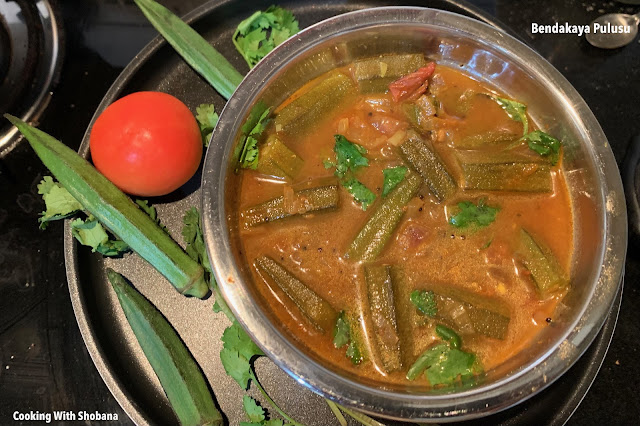
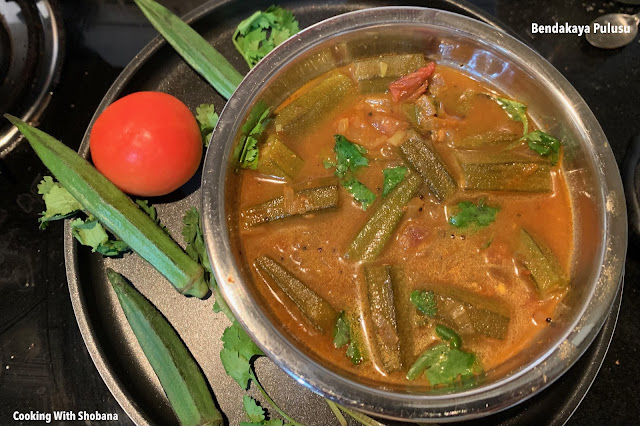
Today's recipe is for a dish made with Bendakaya (Lady's Fingers/Okra) and is called Bendakaya Pulusu. This goes great served with hot steamed rice.


Ingredients:-

  • Bendakaya, (Lady's Fingers/Okra), 250 gms
  • Mustard Seeds, 1/2 tsp
  • Fenugreek (Methi) Seeds, 1/8 tsp
  • Curry Leaves, a few
  • Medium-sized Onions, 2, 
  • Green Chilli, 2 
  • Large-sized Tomato, 1
  • Turmeric Powder, 1/8 tsp
  • Chilli Powder, 1 tsp
  • Coriander Powder, 1 tsp
  • Tamarind, lemon sized ball,
  • Jaggery, 1 tsp
  • Coriander Leaves, 2 tbsp for garnish
  • Oil, 1 and 1/2 tbsp
  • Salt, to taste

Method :-

Wash the okra/ bendakaya thoroughly and dab them dry with a clean kitchen towel
Snip off the two ends of the okra and cut them into 1 " pieces
Chop the onions and tomatoes
Slit the green chillies
Grate the jaggery 
Finely chop the coriander leaves 
Soak the tamarind in 1/2 cup of warm water for about 10 minutes and extract the juice

Heat oil in a thick-borttomrd kadhai and on medium heat add the mustard seeds, when they splutter add the fenugreek seeds and sauté for a few seconds
Add the curry leaves and sauté once again
To this add the chopped onion and slit green chillies and sauté till the onion becomes translucent
Next add the chopped tomatoes, turmeric powder and salt and mix well
Cook covered on medium heat till the tomatoes become soft and mushy
Add the okra and sauté on high heat for 2 to 3 minutes
Add a little more salt, chilli powder, and coriander powder and sauté taking care that the spices don't get burnt
Pour in the tamarind extract, and add the grated jaggery and mix well
Cover and cook for about 3 to 4 minutes on low flame 
Add 1 and 1/2 to 2 cups of water to get the desired consistency
Cook on medium/low flame till the okra gets fully done
Switch off the gas and garnish with finely chopped coriander leaves
Transfer to a serving bowl
Serve Bendakaya Pulusu with hot steamed rice 


Monday, November 22, 2021

MENTHI KURA PAPPU

 MENTHI KURA PAPPU

In the early days, I used to think that Andhra food was mainly biryani and salan! As I started blogging and trying out more dishes from different regions of India,  I realized there are so many wonderful dishes from Andhra. Many of them tend to be spicy which we particularly enjoy. 

Since my husband and I like Andhra cuisine, elsewhere in this blog you will find recipes for dishes from Andhra, such as:-

Today's recipe is for an accompaniment for rice and rotis, made with fenugreek leaves (called Menthi Kura in Telugu) and toor dal. This dal is on the thick side. 

This is quite easy to make and I would recommend you give it a try! I am sure you will like it!!


Ingredients:-


  • Menthi Kura ( Fenugreek Leaves), 2 cups
  • Toor Dal / Arhar Dal, 1 cup
  • Tomatoes, medium- sized, 2
  • Green Chillies, 3
  • Onion, medium-sized, 1
  • Turmeric Powder, 1/4 tsp
  • Salt, to taste
For Seasoning:-
  • Mustard Seeds, 3/4 tsp
  • Cumin Seeds, 3/4 tsp
  • Curry Leaves, 1 sprig
  • Dry Red Chillies, broken into halves, 2
  • Garlic Cloves, 6-8
  • Ghee/ Oil, 1 to 1 and 1/2 tbsp  

Method:-

Remove the fenugreek leaves from their stems, wash them thoroughly and roughly chop them. Keep aside
Chop the onion and tomatoes
Slit the green chillies
Peel and lightly crush the garlic cloves

Wash the toor dal and transfer to a vessel , add the chopped tomatoes and slit green chillies
Pressure cook this in adequate water for 3-4 whistles or till the dal gets cooked
Once the cooker cools, remove the cooked dal and tomatoes, lightly mash it with a ladle and keep aside. 

Heat ghee/oil in a thick-bottomed pan and on medium heat add the mustard seeds
When they splutter add the cumin seeds, and when they sizzle add the curry leaves and the broken red chillies and sauté for a few seconds
To this add the lightly crushed garlic and sauté till it gives off a good aroma
Now add the chopped onion, mix well and sauté till it becomes translucent
Add the fenugreek leaves, turmeric powder, and salt and sauté till they wilt
Next add the cooked dal and tomato mixture and mix well
Add water as required and bring this to a boil  
Lower the flame and let it simmer for a few minutes

Switch off the gas and transfer to serving bowl
Serve the Menthi Kura Pappu with rice or rotis


Saturday, February 13, 2021

KAKARAKAYA PULUSU /BITTER GOURD CURRY

KAKARAKAYA PULUSU (BITTER GOURD CURRY)

Bitter gourd is frequently used in my cooking at home . I use it a lot because though it is bitter as the name suggests, we find it to be very tasty and of course it has many health benefits. It is very strong in Vitamins A and C and helps reduce blood sugar. It is commonly available all over India and is known as Haggalakai in Kannada, Pavakkai in Tamil, Karela in Hindi, and Kaarathe in my mother tongue, Konkani.

Elsewhere in this blog, you will find recipes for dishes made with bitter gourd, such as :- 

Today's recipe is from Andhra cuisine and gets it's name from Kakarakaya or Bitter Gourd in Telugu and Pulusu which is a Tamarind-based gravy. I have adapted this from Kakarakaya Pulusu from the well-known website Hebbar's Kitchen. 

I have preferred to keep this dish semi-dry but please adjust the consistency - adding more water while cooking it - to meet your requirements. 

We enjoyed this dish very much and hope you will, too! 


Ingredients:-
  • Bitter Gourd, about 200 gms
  • Tamarind, size of a lemon, 
  • Small sized Onion, 1
  • Ginger Garlic Paste, 1 tsp
  • Turmeric Powder, 1/4 tsp
  • Jaggery, grated, 1 tbsp
  • Salt,  to taste 
  • Coriander Leaves, finely chopped, 2 tbsp for garnish
To Be Dry Roasted & Ground To A Masala Powder :-
  • Peanuts, 2 tbsp
  • Sesame (Til)  2 tbsp
  • Chana Dal, 1 tsp
  • Urad Dal, 1 tsp
  • Cumin Seeds, 1 tsp
  • Coriander Seeds, 1 tsp
  • Fenugreek (Methi) Seeds, 1/4 tsp
  • Byadgi Red Chillis, 4
For Seasoning:-
  • Mustard Seeds , 1 tsp
  • Urad Dal, 1 tsp
  • Chana Dal, 1 tsp
  • Cumin Seeds, 1/2 tsp
  • Asafoetida (Hing), 1/8 tsp 
  • Dry Red Chilli, 1, broken into halves
  • Oil, 3 tbsp

Method:-


Wash the bitter gourd, snip off the two ends, cut the bitter gourd into roundels and remove the seeds 
Apply salt to the bitter gourd and keep aside for half an hour
Peel and chop the onion 
Soak the tamarind in 1 cup of warm water for about 15 minutes and extract the juice. Keep aside.
In a thick-bottomed kadhai, dry roast the peanuts till they change colour,
Add the sesame seeds, chana dal, urad dal, cumin seeds, coriander seeds, methi seeds and Byadgi Red Chillies and roast on low flame till the dals change colour and the spices give off a good aroma 
Allow the roasted ingredients to cool and then transfer to a small mixer jar and grind to a fine powder. This forms the Masala Powder. Keep aside.
After half an hour of being kept with salt, squeeze out the juice from the bitter gourd 
In the same kadhai, heat 3 tbsp oil and fry the bitter gourd roundels on medium/low flame till they turn golden in colour. Keep aside.
In the remaining oil, do the seasoning by adding the mustard seeds, urad dal, chana dal, cumin seeds, asafoetida, and dry red chilli 
Once the mustard and cumin seeds splutter and the dal change colour, add the chopped onion and sauté till it becomes translucent
To this add the ginger garlic paste and sauté till the raw smell goes
Now add the fried bitter gourd, turmeric powder, and salt and mix well
Add the prepared masala powder and mix well
Next add 1 cup of tamarind extract, grated jaggery and mix well 
Add water as required to get the desired consistency and bring to a boil
Lower the flame and cover and cook for about 5 minutes or till the oil separates
Switch off the gas
Lastly, garnish with finely chopped coriander leaves
Serve Kakarakaya Pulusu with hot steamed rice 


Thursday, August 13, 2020

BEETROOT STIR FRY

 BEETROOT STIR FRY
I have always maintained that it is how it is cooked and not the vegetable itself that makes people like or dislike a particular vegetable. For example, my husband hated beetroot years ago but eats it cheerfully now when I make different dishes with it.

Besides, beetroot is one of the most healthy vegetables as explained in this article, " The Benefits of Beets" in the Mayo Clinic website.

Elsewhere in this blog, you will find recipes for :-
Today's recipe is for an easy to make yet tasty side dish from Andhra Pradesh. Since intrinsically beetroot is sweet the ground powder balances and enhances the taste of this dish. I have adapted this from Beetroot Fry from Sailu's Foods. 

We make this often and have it with rotis or as a side dish with the meal of rice and rasam. 


Ingredients:-
  • Beetroots, 2-3 or about 250 grams
  • Mustard Seeds, 1/2 tsp
  • Asafoetida (Hing), two large pinches
  • Curry Leaves, a few
  • Coriander Leaves, chopped, 2 tbsp
  • Salt, to taste
  • Oil, 1 and 1/2 tbsp + 1 tsp for roasting the ingredients 
Grind To A Coarse Powder :-
  • Groundnuts, 1 tbsp
  • Urad (Black Gram ) Dal, 1 tbsp
  • Coriander Seeds, 2 tbsp
  • Byadgi Dry Red Chillies, 4
  • Tamarind Paste, 1 tsp
  • Jaggery, 1 tsp
Method:-

Wash, peel and finely grate the beetroot . Keep aside
In a thick-bottomed kadhai, dry roast the groundnuts stirring continuously till they turn slightly brown. Remove and keep aside. 
Heat 1 tsp of oil in the kadhai and on medium heat add the Urad Dal
Saute till the dal changes colour and almost turns golden 
Add the coriander seeds and dry red chillies and sauté for a few minutes till the coriander seeds change colour and the red chillies become crisp
Switch off the gas and transfer the roasted ingredients to a bowl and allow it to cool 
In a small mixer jar, grind together the roasted urad dal, Byadgi red chillies, and coriander seeds along with the roasted groundnuts, tamarind paste, and jaggery to form a coarse powder.  Keep aside.
In the same kadhai, heat 1 and 1/2 tbsp oil and on medium heat add the mustard seeds
When they splutter add the asafoetida and sauté for a few seconds till they give off a good aroma
Add the curry leaves and sauté for a few seconds 
To this add the grated beetroot and sauté for 4-5 minutes on medium heat
Lower the heat, and salt to taste
Cover and cook the beetroot, (sprinkle a little water if the beetroot is very dry) and stir from time to time, till the beetroot gets done
Now add the freshly ground coarse powder and mix well
Next add the chopped coriander leaves and cook on low flame for a couple of minutes more
Switch off the gas and transfer the Beetroot Fry to a serving bowl
Serve hot with rice or rotis 


Wednesday, July 22, 2020

DONDAKAYA MASALA

DONDAKAYA MASALA

Today's recipe is for a side dish from Andhra cuisine in which we use ivy gourd stuffed with masala. This goes great with rice and rotis.

Ivy Gourd, called Dondakaya in Telugu, is a commonly available vegetable in India. It is known as Tindora in Hindi, Tendle in my mother tongue, Konkani,  Kovakkai in Tamil, and Thondekayi in Kannada.

According to this article in Lybrate, Ivy Gourd has many properties that are good for our health.

Elsewhere in this blog, you will find recipes with ivy gourd such as Tendle Talasani from our Konkani cuisine, Thondekayi Yennegayi from North Karnataka, and Tindora Masala from North India.

I have adapted this from Dondakaya Masala Curry by Hyderabadi Ruchilu.


Ingredients:-
  • Dondakaya ( Ivy Gourd), 1/2 kg
  • Groundnuts, 2 tbsp
  • Coriander Seeds, 2 tbsp
  • Sesame Seeds, 2 tbsp
  • Cumin Seeds, 1 tsp
  • Fresh Coconut Gratings, 2 tbsp
  • Chilli Powder, 2 tsp or to taste
  • Kitchen King Masala, 1/4 tsp
  • Ginger Garlic Paste, 1 tsp
  • Turmeric Powder, 1/2 tsp
  • Tamarind, marble sized ball
  • Medium-sized Onion, 1
  • Salt, to taste 
  • Oil, 2 tbsp
Method:- 

Wash the ivy gourds and snip off the two ends
Make criss-cross slits in each of them without breaking them ( required for stuffing the ivy gourd with masala). Keep aside.
Chop the onion. Keep aside.

Dry roast the groundnuts in a broad, thick-bottomed kadhai  on medium heat for about 3-4 minutes. When they change colour and give off a good aroma add the coriander seeds, followed by the sesame seeds and when they start popping, add the cumin seeds and roast for a few seconds
To this add the fresh coconut gratings and sauté for a few seconds and switch off the gas
Allow the roasted ingredients to cool, then transfer to a small mixer jar
Add salt, chilli powder, tamarind, Kitchen King masala and grind to a thick, smooth paste, adding very little water
Transfer this to a bowl
Stuff the slits in the ivy gourds with this prepared masala. Please see pictures below.


Heat 2 tbsp oil in the same kadhai and when it gets hot add the chopped onion and sauté till it becomes translucent
Add the turmeric powder and the ginger garlic paste and sauté till the raw smell goes
To this add the stuffed ivy gourd- one by one
Cook covered on medium heat for about 10 minutes, flipping periodically
Cover and cook the flipped ivy gourds for another 10 minutes
Add the remaining ground paste and 1/2 cup of water and mix well
Cook for another 10-15 minutes or till the oil separates
Switch off the gas
Lastly, garnish the Dondakaya Masala with finely chopped coriander leaves
Serve hot with rotis or rice


Monday, April 20, 2020

GUTTI VANKAYA KURA

GUTTI VANKAYA KURA

This vegetable is known by several names: eggplant, aubergine or more commonly as brinjal in India. It is fairly popular in Indian vegetarian cooking and is known as Bhaigan in Hindi, Vaangi in Marathi, Kathirikai in Tamil, Vaingan in Konkani and Vankaya in Telugu.

Eggplants are rich in antioxidants and have numerous health benefits.

I frequently make dishes using eggplants, so elsewhere in this blog you will find recipes for :-

Today's recipe is for a side dish in which eggplants are stuffed with a yummy masala! I have adapted this from Gutti Vankaya Kura from Swasthi's Recipes.

For best results, choose tender baby brinjals so that they get cooked quickly and uniformly.


Ingredients:-
  • Eggplants/Brinjals, 5
  • Medium-sized Onion, 1
  • Ginger Garlic Paste, 1 tsp
  • Green Chillies, 2
  • Tamarind Paste, 1 and 1/2 tbsp
  • Curry Leaves, a sprig
  • Mustard Seeds, 1/2 tsp
  • Cumin Seeds, 1/2 tsp
  • Oil, 2 tbsp
  • Salt, to taste
  • Coriander Leaves, chopped, for garnish
To Roast and Powder For The Stuffing:-
  • Peanuts, 4 tbsp
  • Byadgi Red Chillies, 6
  • Coconut Gratings, 2 tbsp
  • Sesame Seeds, (Til)  1 tbsp
  • Coriander Seeds, 1 tbsp
  • Cumin Seeds, 1/2 tsp
  • Cinnamon (Dalchini) Stick, small, 1
  • Cloves, ( Laung), 2
Method:-

Wash the brinjals and make 2 slits at the base of each of the brinjals keeping the stalk intact
Keep the brinjals in salt water until they are used
Peel and thinly slice the onion and slit the green chillies
In a kadhai, dry roast each of the ingredients listed for the stuffing one by one
Allow them to cool and transfer to a small mixer jar and grind them to a coarse powder
Remove the ground powder to a bowl and mix in salt and tamarind paste
This forms the stuffing for the brinjals
Now stuff each of the brinjals with this stuffing
Heat oil in a thick-bottomed kadhai and on medium heat add the mustard seeds and when they splutter add the cumin seeds and when they sizzle add the curry leaves and sauté for a few seconds
Next add the thinly sliced onions and slit green chillies and sauté till the onions turn slightly golden
To this add the ginger garlic paste and fry till the raw smell goes
One by one add the stuffed brinjals and add any of the stuffing that may have remained
Fry the brinjals for a few minutes till they get well blended with the onions
Add 1/2 cup of water and cook covered on medium flame stirring from time to time till the brinjals get done
You can add more water if required to get the consistency you desire
Switch off the gas, transfer to serving bowl and garnish the stuffed brinjals with finely chopped coriander leaves
Serve Gutti Vankaya Kura with rice or rotis


Sunday, November 3, 2019

DONDAKAYA PACHADI (IVY GOURD CHUTNEY)

DONDAKAYA PACHADI ( IVY GOURD CHUTNEY)

One of the veggies I use pretty often is Ivy Gourd, variously called Dondakaya in Telugu,
Tindora in Hindi, Thondekayi in Kannada and Tendle in my mother tongue, Konkani. This vegetable is used all over the country.

Elsewhere in this blog you will find recipes for Tendle Bhuthi from Konkani cuisine, Thondekayi Yennegayi,  from North Karnataka and the North Indian Tindora Masala.

Today's recipe is for a chutney from Andhra called Dondakaya Pachadi and has been adapted from the popular cooking website Sailu's Foods.

For best results, choose ivy gourd that are tender yet firm.

Traditionally, this Dondakaya Chutney is served with steaming hot rice and ghee.


Ingredients:-
  • Dondakaya, (Ivy Gourd), 250 grams, 
  • Cumin Seeds, 1 tsp
  • Channa Dal ( Bengal Gram), 1 and 1/2  tbsp
  • Urad Dal (Black Gram Dal), 1 tbsp
  • Byadgi Red Chillies, 2 
  • Green Chillies, slit, 3, 
  • Garlic Cloves, peeled and lightly crushed, 6 
  • Tamarind, size of a small marble  
  • Jaggery, grated, 1/2 tsp
  • Salt, to taste
  • Oil, 1 tbsp
For Seasoning :-
  • Mustard Seeds, 1/2 tsp
  • Hing (Asafoetida) Powder, a pinch
  • Curry Leaves, a sprig
  • Oil, 1 tsp
Method:-

Wash the ivy gourd and snip off their ends and cut them into thin roundels
In a thick-bottomed kadhai, heat oil and on medium heat add the cumin seeds, channa dal, Urad dal and red chillies and sauté till the dals change color
To this, add the slit green chillies and the peeled garlic, followed by the ivy gourd, mix well and cook uncovered for about 10 minutes stirring from time to time till the ivy gourd turns slightly golden
Switch off the gas, allow this to cool and transfer contents to a mixer jar
Next, add the tamarind, salt, grated jaggery and  2 tbsp of water
Grind to a coarse paste in pulse mode and transfer the ground chutney to a bowl
Heat 1 tsp of oil in a small pan and do the seasoning by adding the mustard seeds on medium heat
When they splutter, add the asafoetida powder and the curry leaves and sauté for a few seconds
Pour this seasoning on to the Dondakaya Pachadi
Serve this as an accompaniment with hot steamed rice


Friday, May 10, 2019

MAMIDIKAYA MENTHI PACHADI

 MAMIDIKAYA MENTHI PACHADI

There are different types of pickles that we make using raw mangoes which are available in plenty during these summer months. Elsewhere in this blog, you will find recipes for Raw Mango Palu, Raw Mango Thokku, and Instant Sweet Raw Mango Pickle.

 I prefer these instant pickles as they are easy to make and can be made quickly.  They do not call for a long waiting/pickling period unlike the regular pickle. In fact, today's instant raw mango pickle can be consumed within a day of its making.

I used the Totapuri variety of raw mangoes. The advantage of this is that you can use it with the skin.

Today's recipe for one such pickle from Andhra Pradesh has been adapted from Mamidikaya Menthi Pachadi from Sailu's Kitchen. It gets it's name from the Telugu words for Raw Mango ( Mamidikaya) and Fenugreek Seeds ( Menthi).

 When refrigerated in an air tight bottle, this pickle can last for about 2-3 months. Make sure you use a clean dry spoon each time you serve the pickle.


Ingredients:
  • Totapuri Raw Mangoes, chopped, 2 heaped cups,  each cup = 240 ml. 
  • Fenugreek Seeds, 1 heaped tsp
  • Mustard Seeds, 1 tbsp
  • Chilli Powder, 2 tbsp
  • Asafoetida (Hing) Powder, 1/2 tsp
  • Salt, to taste 
  • Sesame Oil or Groundnut Oil, 100 ml or a little less than 1/2 cup 
Method:

Wash the raw mangoes and wipe them dry. Chop the mangoes with the skin. Discard the central seed.
In a pan, dry roast the mustard seeds till they pop and then set them aside
Dry roast the fenugreek seeds till they change colour and become a liitle red.
Transfer the dry roasted mustard seeds and fenugreek seeds to a small mixer jar
Grind them together to a fine powder and keep aside.
Heat oil in a heavy-bottomed kadhai and when it is hot add asafoetida powder and immediately turn off the flame. Allow the oil to cool to room temperature. Keep aside.
In a large bowl, mix together the chopped mango pieces, chilli powder, salt, roasted mustard and fenugreek seeds powder till they are well blended 
To this, add the oil that you have infused with asafoetida and mix well 
Transfer to a clean, dry bottle and refrigerate 


Thursday, March 14, 2019

DRUMSTICK IGURU

DRUMSTICK IGURU

In the summer months, Drumsticks are one of the commonly available vegetables. In my house, we are all fond of drumsticks, which we call "Mashingasaang" in my mother tongue, Konkani. They are called Nuggekayi in Kannada, Muringakkai in Tamil, and Shevage in Marathi.

Elsewhere in this blog, you will find recipes for dishes made with drumsticks such as Potato & Drumsticks Upkari,  Drumstick Tomato Curry, and Drumsticks Pithla.

Today's recipe is for a dish from Andhra cuisine. It is called Iguru and is a thick gravy usually served as an accompaniment for hot rice. This is adapted from the YouTube Video for Drumsticks Igru by Subbu's Kitchen.

We enjoyed this dish and I hope you will like it as much as we did.


Ingredients:-
  • Drumsticks, 2
  • Onions, finely chopped, 2
  • Green Chillies, slit, 2
  • Turmeric Powder, 1/2 tsp
  • Tomatoes, finely chopped, 2
  • Chilli Powder, 1 tsp
  • Salt, to taste
  • Oil, 2 tbsp
To Grind To A Paste:-
  • Poppy Seeds, (Khus Khus), 1/4 cup
  • Coriander Seeds, 2 tsp
  • Cumin Seeds, 1 tsp
  • Garlic Cloves, 6
Method:-

Wash and chop the drumsticks into 2 " pieces, peel them and keep aside. I prefer to peel them but you can use them without peeling them too.
In a mixer, grind together the poppy seeds, coriander seeds, cumin seeds and garlic cloves adding water a little by little to a smooth paste. Keep aside
Heat oil in a thick-bottomed pan and when it gets hot add the chopped onions and a little salt and saute for 4-5 minutes
Now add the drumstick pieces, slit green chillies and turmeric powder
Cover the pan and cook the drumsticks on low flame without adding any water ( the drumsticks and onions should get cooked in their own juices)
Stir occasionally and cook till the drumsticks get done
To this add the ground paste prepared earlier and mix well
Add the chilli powder, the finely chopped tomatoes, salt and mix well
Cook on medium flame till the tomatoes become soft and the raw smell of the ground paste goes
Cover and cook for another 10 minutes till the Iguru becomes thick
Add a little water to adjust the consistency 
Transfer to serving bowl and serve the Drumsticks Iguru with rice


Friday, December 14, 2018

MUSHROOM CURRY ANDHRA STYLE

MUSHROOM CURRY ANDHRA STYLE

I use Button Mushrooms in dishes made for lunch or dinner from time to time as they have numerous health benefits. This article in the website of Livestrong , "The Health Benefits of Button Mushrooms" lists these in some detail.

We make dishes from different parts of India with button mushrooms. For example, elsewhere in this blog, you will find recipes for Chilli Mushroom, Matar Mushroom,  and Mushroom Chettinad.

Today's recipe is from Andhra Pradesh and is adapted from a YouTube video "Andhra Style Mushrooms" from Sanjeev Kapoor Khazana.

The original recipe called for the use of Dried Coconut Strips but I have used the regular coconut gratings. I have also not garnished the dish with dried coconut strips.


Ingredients:-
  • Button Mushrooms, 200 grams
  • Mustard Seeds, 1 tsp
  • Garlic Cloves, finely chopped, 7
  • Medium-sized Onion, finely chopped, 1
  • Curry Leaves, 7-8
  • Crushed Black Peppercorns, 1/4 tsp
  • Coriander Leaves, finely chopped, 1 tbsp
  • Salt, to taste
  • Oil, 1 and 1/2 tsp
To Grind To A Paste:-
  • Coconut Gratings, 1/3 cup 
  • Byadgi Red Chillies, 4
  • Bay Leaf, 1
  • Cinnamon, 1 "
  • Coriander Seeds, 1 tsp
  • Split Black Gram, (Urad Dal), 1 tsp
  • Green Cardamoms, 2-3
  • Cumin Seeds, 1 and 1/2 tsp

Method:-

Wash and clean the mushrooms by dabbing them with a wet cloth and patting them dry
Quarter or slice the mushrooms into halves depending on their size

Heat 1/2 tsp of oil in a non-stick pan and when it gets hot add the coconut gratings, red chillies, bay leaf, cinnamon, coriander seeds, split black gram, green cardamoms, and cumin seeds and roast till  it gives off a good aroma 
Switch off the gas and allow it to cool
Transfer to small mixer jar and grind into a fine paste adding just the required amount of water

In the same non-stick pan, heat the remaining 1 tsp of oil and on moderate heat add the mustard seeds and when they splutter add the finely chopped garlic and saute till if turns golden
To this add the finely chopped onion and curry leaves and saute till the onions get slightly browned
Add the prepared ground paste and saute till the raw smell goes
Now add the mushrooms and salt to taste, mix well and cook for 3-4 minutes on medium flame
Next add the freshly crushed peppercorns and chopped coriander leaves and mix well
Lastly, add very little water to adjust the consistency and cook for 1 minute
Transfer to serving bowl and serve hot with rice or rotis


Friday, April 20, 2018

PALAKOORA PAPPU (SPINACH DAL)

PALAKOORA PAPPU (SPINACH DAL)


From time to time, I like to try out dishes from different parts of India. Today's dish is "Palakoora Pappu" or spinach dal cooked in the Andhra style. It derives it's name from the main ingredients of spinach and dal. We had this with rotis and it tasted great!

Elsewhere in this blog, you will find other recipes from Andhra Pradesh such as Pesarattu, Allam Pachadi,  and Mamidikaya Pappu.

Today's recipe has been adapted from Dal Palak/Spinach Dal or Palakoora Pappu by Chef Sanjay Thumma of Vah Chef.

Make sure that the cooked Toor Dal is well mashed for this dish. The recipe called for the addition of fenugreek (methi) leaves if desired but I didn't use this. If you are using fenugreek leaves, the ratio should be 70 of spinach to 30 of fenugreek leaves.


Ingredients: 
  • Palak ( Spinach) 2 bunches, 
  • Cooked Toor Dal, boiled and mashed, 1 cup
  • Onion, chopped, 1
  • Large-sized Tomatoes, chopped, 2
  • Green Chillies, slit, 2
  • Butter, 1 tbsp
  • Salt, to taste
  • Oil, 1 tbsp
For the Seasoning: 
  • Mustard Seeds, 1/4 tsp
  • Cumin Seeds (Jeera), 1/2 tsp
  • Garlic Cloves, chopped, 5
  • Whole Red Chillies, broken in to halves, 2
  • Asafoetida, (Hing) a pinch (optional) 
  • Turmeric Powder, a pinch
  • Curry Leaves, a sprig
Method: 

Remove the palak leaves (spinach) from their stems and wash them in several changes of water
Transfer to a collander and allow the water to drain.
Roughly chop the spinach and keep aside.
Heat 1 tbsp of oil in a pan and when it gets hot, on medium heat add the mustard seeds and when they splutter add the jeera (cumin seeds) and when they sizzle add the chopped garlic, whole red chillies broken into halves, and a little salt
Saute till it gives off a good aroma and changes colour
Add asafoetida, turmeric and curry leaves and saute for a few seconds
Next add the chopped onion and green chillies and butter and saute till the onion becomes translucent. (Do not let the onion get browned)
Add the chopped tomatoes before the butter melts fully
Now cover and cook tomatoes for a few minutes till they become soft
Add spinach and cook uncovered on medium heat for 2 minutes
To this, add the cooked and mashed toor dal and enough water to get the desired consistency
Check for salt and add if required
Bring to a boil then allow it to simmer for a couple of minutes
The pakoora pappu is likely to thicken when it cools
You may have to add a little water to adjust the consistency
Serve hot with rotis or rice