Showing posts with label Maharashtrian recipe. Show all posts

Monday, April 28, 2025

KAIRICHI THECHA

 KAIRICHI THECHA

Here in India, we associate the hot summer days with raw mangoes being available in plenty. Raw mangoes are called Kairi in Marathi, Maavinkayi in Kannada, Mamidikayi in Telugu, and Ambuli in my mother tongue, Konkani.

No kid growing up in India would have missed that great experience of eating slices of raw mango dipped liberally in salt and chilli powder! 

As this article explains, raw mangoes have numerous health benefits.

Elsewhere in the blog, you will find recipes for dishes made with raw mangoes, such as:-

Today's recipe - Kairichi Thecha- is from Maharashtrian cuisine. Raw Mango is called Kairi in Marathi. Thecha is a dry chutney-like popular accompaniment for bhakri and roti. 

Traditionally, thecha is made using a mortar and pestle. These days since most people use mixers, I must mention that the grinding should only be done in the pulse mode to get the coarse texture required for the thecha.

Do try this out and I am sure you will love it! 


Ingredients:- 

  • Kairi (Raw Mango), 1 of about 240 grams
  • Green Chillies, 10
  • Roasted Peanuts, 1/3 cup
  • Garlic Cloves, 8
  • Cumin Seeds, 1/2 tsp
  • Coriander Leaves, 1 handful
  • Salt, to taste
  • Oil, 1 tsp 
Method:-

Wash the raw mango and wipe it dry. 

Peel and cut the raw mango into cubes and discard the core

Wash the green chillies, remove the stalks, pat them dry and slit them 

Wash, dry and finely chop the coriander leaves

Peel the garlic cloves


Heat 1 tsp of oil in a kadhai and roast the slit green chillies stirring continuously till they get spotted  

Remove from the kadhai and allow them to cool

Transfer to a mixer jar

To the roasted green chillies, add the roasted peanuts, garlic cloves, cumin seeds, coriander leaves and salt to taste. 

Add the raw mango cubes. 

Grind on pulse mode till the ingredients are crushed and blended to get the Kairichi Thecha with a coarse texture

Transfer to serving bowl

Serve as accompaniment to bhakri/roti


Wednesday, April 5, 2023

DODKA (RIDGE GOURD) BHAJI

 DODKA (RIDGE GOURD) BHAJI


Ridge gourd is called Ghosale in my mother tongue, Konkani. It is called Dodka in Marathi, Turai in Hindi and Heerekayi  in Kannada. We use ridge gourd at home from time to time as it has various properties that make it good for health. 


Elsewhere in this blog you will find recipes for other dishes made with ridge gourd such as:-

I have adapted today's recipe from Turai ki Subzi from the well-known cookery website, Veg Recipes of India.

Tip: It is essential  to first taste the ridge gourd and make sure it is not bitter before using it in any dish. 

We tried out this easy to make dish recently and I must say it tasted great. 


Ingredients:-


  • Dodka (Ridge Gourd), 250-300 gms 
  • Moong Dal, 2 tbsp
  • Medium-sized Onion, 1
  • Green Chilli, 2
  • Garlic Cloves, 4
  • Turmeric Powder, 1/8 tsp
  • Asafoetida, (Hing), 1/8 tsp
  • Fresh Coconut Gratings, 1/4 cup
  • Coriander Leaves, 2 tbsp
  • Oil, 1 and 1/2 tbsp
  • Salt, to taste
Method:-

Wash the ridge gourd and cut off the two ends
Peel and chop the ridge gourd to bite-size pieces
Chop the onion and garlic
Finely chop the green chillies and coriander leaves

Heat oil in a thick-bottomed kadhai and add the chopped onions and garlic
Saute on medium heat till the onions become translucent 
Add the chopped green chillies, turmeric powder and asafoetida and mix well
To this add the chopped ridge gourd and the soaked moong dal and the water in which it was soaked
Add salt to taste
Cover and cook on medium heat till the ridge gourd gets done 
Now add the freshly grated coconut and the finely chopped coriander leaves 
Mix well and switch off the gas
Transfer the Dodka Bhaji to serving bowl
Serve hot with chapati or as a side dish with the main meal 


Sunday, January 9, 2022

CABBAGE VADI

 CABBAGE VADI

One vegetable that it popular all over India is cabbage. It is called "Patta Gobhi" in Punjabi, "Bhand Ghobi" in Hindi, Khobi in Marathi and Elekosu in Kannada. There are many health benefits of cabbage as detailed in this informative slide show from WebMD. 

We make many dishes at home using cabbage. Today, I have selected some of the less commonly made but very tasty dishes of cabbage featured in this blog, like :-

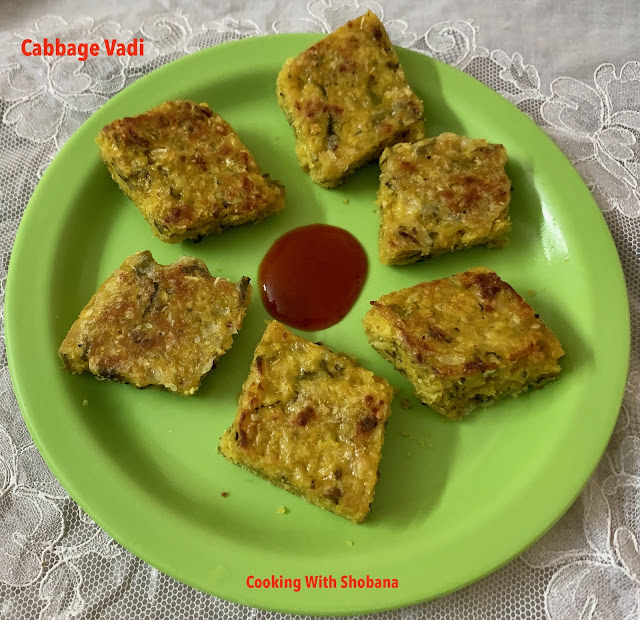
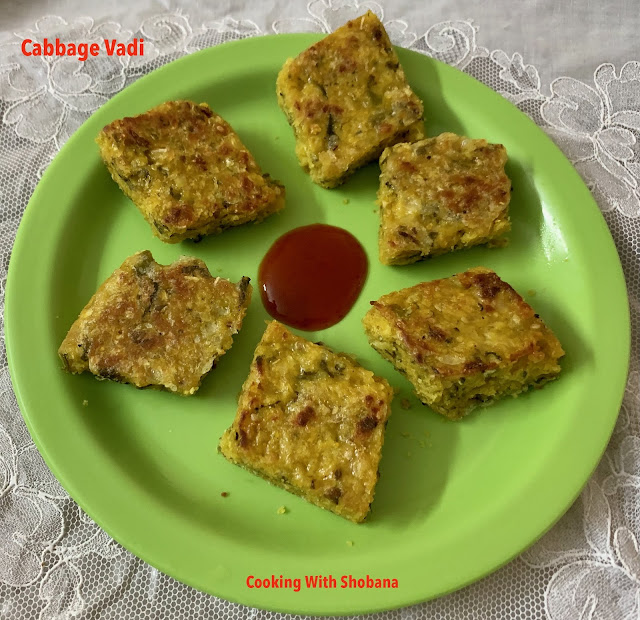
Today's recipe is for Cabbage Vadis, which is tasty snack from Maharashtra. I have adapted this from Patta Gobhi ki Vadi in Ray Kitchen. 

This can be had steamed, or shallow or deep fried if you want them to be more crisp. I chose to shallow fry them today. 

We enjoyed this snack with a hot cup of tea! 


Ingredients:-

  • Cabbage, 250 gms or  shredded, 2 cups 
  • Garlic Cloves, 7 
  • Green Chillies, 3
  • Ginger, 1 " piece
  • Besan (Chickpea Flour), 1 cup
  • Rice Flour, 2 tbsp
  • Rava (Semolina), 2 tbsp
  • Til (White Sesame Seeds), 1 tbsp
  • Ajwain (Carom Seeds), 1/2 tsp
  • Hing (Asafoetida), 1/4 tsp
  • Turmeric, 1/2 tsp
  • Coriander- Cumin Powder, 1 tsp
  • Oil, 1 tsp
  • Water, 1 tsp
  • Fresh Coriander Leaves, 1/2 cup
  • Cornflour, 3 tbsp
  • Salt, to taste
  • Oil, as required for frying + for greasing the plate 
Method:-

Wash and shred the cabbage
Finely chop the coriander leaves
In a small mixer jar, grind together garlic cloves, green chillies, and ginger to a paste without adding any water. Keep aside
Keep the shredded cabbage in a bowl and add coriander leaves and the freshly ground paste. 
To this add besan, rice flour, semolina, salt, sesame seeds, carom seeds, asafoetida, turmeric powder, and coriander-cumin powder with 1 tsp of oil
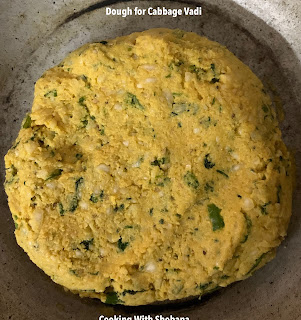
Mix thoroughly with your fingers. The cabbage will release a little water on its own. If the mixture is still too dry, add 1 tsp of water, and mix to form a soft dough


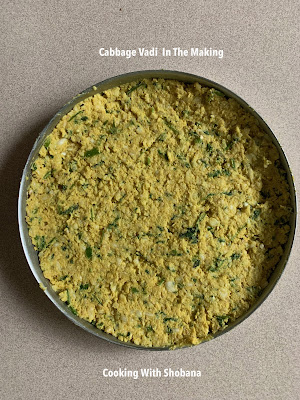
Grease a plate with oil and spread this dough evenly on to this plate


Place the plate with the dough in a steamer and cook the cabbage mixture for about 12 to 15 minutes on medium flame till it gets done
Switch off the gas, remove the plate and allow it to cool
With a knife cut the steamed cabbage to form squares (vadis) and demould them
The Cabbage Vadi can be had as they are or can be shallow fried or deep fried, if desired, to make them  more crisp
In case you can choose to fry, take a bowl with 3 tbsp of cornflour and make a slurry adding 1/4 cup of water
Dip each of the vadis in this slurry and deep fry in a kadhai or shallow fry on a tawa
Serve the Cabbage Vadi with a chutney of your choice or with Tomato Ketchup


Wednesday, October 27, 2021

CHAVALI MASALA

 CHAVALI MASALA

Black-eyed beans are called Chavali in Marathi, Alasande Kaalu in Kannada, and Lobia in Hindi. It is well-established that lobia has numerous health benefits. 

I make dishes using chavali quite often. Elsewhere in this blog, you will find recipes for other dishes made with chavali, such as :-

Today's recipe is for a yummy side dish made with Chavali that goes great with rotis. I have adapted this from Chavalichi Bhaji /Chavali Masala , a dish from Maharashtra, which I came across in Madhura's Recipes. 

When soaking the chavali, please note that 1/2 cup of chavali when soaked will grow in volume to be about 1 and 1/4 cups.

Do try this out and I am sure you will love it as much as we did. 


Ingredients:-

  • Chavali, 1/2 cup
  • Medium-sized Onions, finely chopped, 2
  • Tomato, finely chopped, 1 
  • Mustard Seeds, 1/2 tsp
  • Cumin Seeds, 1/2 tsp
  • Ginger Garlic Paste, 1 tsp
  • Chilli Powder, 1 tsp
  • Coriander Powder, 1 heaped tsp
  • Fresh Coconut Gratings, 1 tbsp 
  • Kitchen King Masala, or Garam Masala, 1/2 tsp
  • Jaggery, grated, 1 tsp, or to taste
  • Salt, to taste
  • Oil, 1 tbsp
  • Coriander Leaves, finely chopped, 2 tbsp , for garnish 
Method:-

Wash and soak the chavali in adequate water for at least 5-6 hours or overnight
Discard the water 
Please note that 1/2 cup of chavali when soaked will grow in volume to be about 1 and 1/4 cups
Pressure cook the soaked chavali in adequate amount of fresh water,  adding a little salt, for about 2-3 whistles
When the cooker cools, remove the chavali and keep aside 
Strain the water in which the chavali was cooked. Keep aside
Heat 1 tbsp oil in a thick-bottomed kadhai and on medium heat add the mustard seeds
When they splutter add the cumin seeds and when they sizzle add the finely chopped onion and sauté for 5-6 minutes or till it turns slightly golden in colour 
To this add the finely chopped tomato, ginger garlic paste, coriander powder, chilli powder, and Kitchen King masala, and salt to taste. Mix well
Cook till the tomato becomes soft and mushy 
Now add the grated coconut and grated jaggery
Mix well and cook covered on medium heat for about 5 minutes stirring from time to time till the onions and tomato are well blended with the spices 
Next add the cooked chavali and as much of the strained water as required to get the right consistency 
Bring to a boil, reduce the heat and let it simmer for about 5 minutes 
Lastly, switch off the gas and garnish the Chavali Masala with the finely chopped coriander leaves 
Transfer to serving bowl
Serve Chavali Masala with hot rotis or rice 


Monday, August 23, 2021

GULACHA SHEERA

 GULACHA SHEERA

Today's recipe is called Gulacha Sheera and is popular in Maharashtra. Apart from loving the taste of this dessert, I like the fact that we use  jaggery to make it. Jaggery gives the dish adequate sweetness and is a more healthy option than using sugar which is normally used to make sheeras.

Over the last few years, I have consciously tried to use jaggery instead of sugar. This article in The Times of India details the benefits of jaggery over sugar in our diets. 

Elsewhere in this blog, you will find other dishes in which we use jaggery such as:-

I made this recently as neivedhya for Varamahalakshmi festival . Please try out this Gulacha Sheera and I am sure you will enjoy it! 


Ingredients:-

  • Rava/ Semolina, 3/4 cup
  • Jaggery, grated, 1/2 cup, or to taste
  • Warm Water, 1 and 1/2 cups 
  • Ghee, 2 and 1/2 tbsp
  • Cashewnuts, broken into pieces, 1 tbsp
  • Raisins, 1 tbsp
  • Cardamoms 2-3, made into a powder
Method:-

Dissolve the grated jaggery in 1 and 1/2 cups of warm water. Heat if required for it to dissolve completely. Keep aside. 
Peel the cardamoms and crush them to a powder. Keep aside.

Heat a thick bottomed pan and on medium heat add 1/2 tbsp of ghee. Roast the broken cashewnuts till they turn slightly golden. Keep aside
Next add the raisins and fry till they puff up. Keep aside. 

In the same pan, add 1 tbsp of ghee and roast the rava on medium heat stirring constantly till it gives off a good aroma and turns slightly golden in colour

To this add the jaggery water and mix well taking care that there are no lumps
Cook till the rava gets done and the excess water gets absorbed, stirring constantly 
Now add 1 tbsp of ghee, roasted cashewnuts, roasted raisins and cardamom powder and mix well
Continue to stir till the mixture leaves the sides of the pan and forms a ball

Apply some ghee  to the insides of a bowl. Transfer the Gulacha Sheera to this bowl. 
Garnish with raisins or nuts as you wish 


Friday, June 4, 2021

METHAMBA

 METHAMBA

Children and adults alike wait eagerly for the hot summer months in India as this is the season for mangoes! There are so many different types of mangoes available and people have their own special preferences for one variety or another. 

Quite apart from the ripe mangoes, we make use of raw/green mangoes too in a wide variety of dishes.  These range from cooling drinks, different kinds of chutneys and pickles, and tarty jams and relishes. 

Besides being so tasty, raw mangoes help in the hot summer by preventing dehydration, and have numerous health benefits. 

Elsewhere in this blog you will find recipes for dishes made with raw mango such as:- 

Today's recipe is from Maharashtrian cuisine. It is a sweet, hot and tangy relish called Methamba which gets its name from two ingredients Methi (Fenugreek Seeds) and Amba ( Mango). 

The Methi gives a nice flavour to the dish and you can adjust the quantity based on your individual preference. Once you make the Methamba in a larger quantity, allow it to cool. Store this in air tight containers in the refrigerator and use as required. 

We are big fans of Methamba and we simply love it! 


Ingredients:-


  • Raw Mango, 1 or Chopped Raw Mango, about 1 heaped cup 
  • Fenugreek (Methi) Seeds, 3/4 tsp
  • Jaggery, grated, 1/2 cup or to taste
  • Mustard Seeds, 1/2 tsp
  • Asafoetida, (Hing) 1/8 tsp
  • Turmeric Powder, 1/4 tsp
  • Chilli Powder, 1 tsp 
  • Salt, to taste
  • Oil, 1 to 1 and 1/2 tbsp 
Method:-


Wash the raw mango, dab it dry, peel, cube and keep aside discarding the seed
Heat oil in a pan and on medium heat add the mustard seeds, when they splutter add the fenugreek seeds and sauté till they become golden brown
To this add the asafoetida and turmeric powder and sauté for a few seconds
Now add the cubed mango pieces, salt, and chilli powder, mix well and fry for 1-2 minutes
Add 1/2 cup of water and cover and cook on medium heat till the mangoes get done 
Add the grated jaggery, mix well and cook on low flame for about 5 minutes till the jaggery melts fully and blends well with the mango pieces  
Switch off the gas and transfer the Methamba to serving bowl and serve as a relish 


Friday, November 15, 2019

PALAK ZHUNKA

PALAK ZHUNKA

Today's recipe Palak Zhunka is for an easy to make side dish made with Spinach ( "palak" in Hindi), Besan (Chickpea Flour) and spices. This type of side dish is called "Zhunka " in Maharashtra, Goa and the Northern part of Karnataka.

We make many dishes using spinach in India. For example, elsewhere in this blog you will find dishes as diverse as Palak Corn Subzi, Palak Parantha, and the famous Palak Paneer!

We enjoyed this Palak Zhunka with hot rotis.


Ingredients:-
  • Palak, (Spinach) , 1 large bunch or about 200 gms
  • Besan, (Chickpea Flour) 1 cup 
  • Large-sized Onion, 1
  • Green Chillies, 2
  • Garlic Cloves, 3
  • Turmeric Powder, 1/4 tsp
  • Chilli Powder, 1/4 to 1/2 tsp (optional)
  • Mustard Seeds, 1 tsp
  • Cumin Seeds, 1/2 tsp
  • Salt, to taste
  • Oil, 2 tbsp

Method:-

Remove the palak leaves from their stalks and wash them in several changes of water
Chop the palak fine and keep aside
Chop the onion and finely chop the green chillies and garlic cloves
In a pan, dry roast the besan on medium heat for 3-4 minutes or till it gives off a good aroma. Keep aside. 
Heat oil in the same pan and on medium heat add the mustard seeds and when they splutter add the cumin seeds. When the cumin seeds sizzle, add the finely chopped garlic and sauté till it turns slightly golden brown 
To this, add the chopped onions and green chillies and sauté till the onions become translucent
Add the turmeric powder and chilli powder ( if being used) 
Next add the chopped palak and salt
Mix well and cook the palak till it is almost done. ( Please note that palak gets cooked very fast. Also that salt added to the palak will release water) 
Now mix in the dry roasted besan and sprinkle a little water
Cover and cook on medium flame till the besan gets cooked, stirring from time to time till it gets well blended with the palak
Switch off the gas and transfer the Palak Zhunka to a serving bowl
Serve hot as a side dish


Tuesday, April 23, 2019

PATICHYA KANDYACHI ZUNKA

PATICHYA KANDYACHI ZUNKA

 There is something cute about spring onions which I like, apart from the taste of course. There are many dishes you can make using spring onions. Elsewhere in this blog, you will find recipes such as Sweet Corn & Spring Onion Soup, Spring Onion & Chilli Fried Rice, from Indian-Chinese cuisine and Spring Onion Bhuthi from our own Konkani cuisine.

Today's dish is from Maharashtrian cusine. Patichya Kanda means spring onions in Marathi while Zunka is a popular besan ( gram flour) based dish. This dish is served with phulkas or rotis.  I have adpated this recipe from "Patichya Kandyachi Zunka" by Swapna Sunil in Better Butter.


Ingredients:-
  • Patichya Kanda ( Spring Onions), finely chopped, 2 cups
  • Besan ( Gram Flour), 1 cup
  • Green Chillies, chopped, 3, or to taste 
  • Turmeric Powder, 1/4 tsp
  • Chilli Powder, 1 tsp
  • Mustard Seeds, 1 tsp
  • Cumin Seeds, 1 tsp
  • Curry Leaves, a few
  • Oil, 2 tbsp
  • Salt, to taste

Method:

Wash and clean the spring onions. Separate the bulbs from the greens, finely chop both the bulbs and the greens and keep aside
In a thick-bottomed kadhai, dry roast the besan on medium heat, stirring continuously till it gives off a good aroma. Keep aside. 
Heat oil in the same kadhai and on medium heat add the mustard seeds and when they splutter add the cumin seeds. When the cumin seeds change colour add the curry leaves and saute for a few seconds
Now add the chopped green chillies and saute for half a minute
To this add the chopped spring onion whites  (bulbs) and saute till translucent
Next add the spring onion greens and salt. Mix well and cook on medium flame till the spring onions get done  
Add the turmeric powder, chilli powder and the dry roasted besan, little by little, and mix well
Sprinkle a little water and cook covered on medium flame, stirring from time to time, till the besan gets fully cooked ( about 8-10 minutes)
Typically, the texture of the zunka should be crumbly.
Transfer the zunka to a serving bowl and serve hot with phulkas or rotis


Monday, March 25, 2019

SHEPU CHA DOSA

SHEPU CHA DOSA

Dill Leaves, called Shepu in Konkani and Marathi and Sabsigge Soppu in Kannada, have a smell and flavour of their own. In my experience, dill leaves triggers two reactions from people. Some love the flavour and smell while others don't ! There is seldom a neutral reaction.

I love dill leaves and use them in dishes whenever I can. Elsewhere in this blog, you will find recipes like Moong Dal with Dill Leaves, Nuchina Unde, and Lobia Suva Bhaji Subzi which make use of dill leaves.

Today's recipe is a dosa called Shepu Ghavan in Maharashtra which has dill leaves and jaggery too. This is called Shepu Pole in Konkani. 

While the jaggery adds sweetness to the dosa, please note that too much of jaggery will make it difficult to make the dosas. Do try it out. I am sure you will love it - if , like me, you are one of those who enjoy the flavour of dill leaves.

You can use ghee or oil to make these dosas. Ghee enhances the taste but you can use oil depending on your preference and what you are used to.

This recipe has been adapted from Shepu cha Dosa, by Kalpana Talpade of Kalpana's Kitchen.


Ingredients:-

  • Shepu (Dill Leaves), A bunch -  to yield 1 cup  
  • Rice, 1 cup
  • Fenugreek Seeds (Methi Seeds), 1/2 tsp
  • Fresh Coconut Gratings, 1/3 cup
  • Jaggery, grated, 1/3 cup
  • Water, for grinding the batter, 1/3 cup + 1/3 cup for adjusting the batter consistency 
  • Ghee/Oil, as required to make dosas
  • Salt, to taste

Method:-

Remove the shepu leaves from their stems, discard the stems and wash the shepu leaves thoroughly 
Wash and soak the rice along with the fenugreek seeds in a bowl for about 4-5 hours
After 4-5 hours, discard the excess water
In a mixer jar, add the soaked rice and fenugreek seeds, fresh coconut gratings, grated jaggery and salt along with 1/3 cup of water
When the grinding is half done, add the shepu leaves and grind once again till it forms a smooth batter
Transfer to a vessel, keep it covered and allow it to ferment overnight or for 8-10 hours
Next morning, add 1/3 cup of water to adjust the consistency of the dosa batter
The batter should be slightly thick
Heat the dosa tawa and when it is hot enough, sprinkle some water to check the heat and pour the batter to make a thickish dosa
Add ghee/oil on top and on the sides of the dosa
Cover and cook on medium heat till one side gets done
Next flip and cook the other side adding more ghee/oil as required
Wipe the tawa with clean tissue paper after you make each dosa


Wednesday, September 26, 2018

SHIMLA MIRCH ZHUNKA

SHIMLA MIRCH ZHUNKA

I am fond of some dishes from Maharashtrian cuisine and make them once in a while. You will therefore find elsewhere in this blog recipes for Jhunka Vadi, Kothimbir Vadi, and Hirwi Mirchi cha Thecha. 

Today's recipe is for an easy to make side dish which can be had with rotis or rice called Shimla Mirch Zhunka (also called Jhunka) made with capsicum/bellpepper and besan ( chickpea flour). This is also commonly made in North Karnataka.

I particularly like it if the capsicum stays crunchy without being overcooked.


Ingredients:-
  • Shimla Mirch (Capsicum/Bellpepper), large sized, 2 or about 500 gms
  • Besan ( Chickpea Flour), 3 tbsp
  • Onion, finely chopped, 1
  • Garlic Pods, chopped, 3-4
  • Green Chilli, ( long variety), chopped, 1
  • Turmeric Powder, 1/4 tsp
  • Chilli Powder, 1 tsp
  • Coriander Powder, 1 tbsp 
  • Mustard Seeds, 1/2 tsp
  • Cumin Seeds, 1/2 tsp
  • Hing, (Asafoetida), 1/8 tsp
  • Curry Leaves, a sprig
  • Salt, to taste
  • Oil, 2 tbsp
  • Coriander Leaves, finely chopped, for garnish

Method:- 

Wash the capsicum, de-seed them and chop them into 1/2 inch cubes
Heat a thick bottomed, non-stick kadhai and dry roast the besan over medium/low flame stirring continuously till it gives off a nice aroma or for about 2-3 minutes. Keep aside
Heat oil in the kadhai and when it gets hot, on medium heat add the mustard seeds and when they splutter add the cumin seeds
When the cumin seeds sizzle add the asafoetida and curry leaves and saute for 10 seconds
Next add the green chilli, onion, garlic and a pinch of salt and saute for a couple of minutes till the onion becomes translucent 
Add the cubed capsicum, salt to taste and cook for about 5 minutes
Add the spice powders (turmeric powder, chilli powder, and coriander powder) and mix well, and cook on medium flame till the capsicum gets done. Take care that the capsicum does not get overcooked or mushy. It should be cooked yet retain its crunchiness.
Now sprinkle the dry roasted besan, little by little and mix well so that it does not form any lumps
Cook, partially covered, over medium flame till the dry roasted besan gets well blended with the capsicum and spice powders
Finally garnish with finely chopped coriander leaves
Serve hot as a side dish with rice or rotis


Wednesday, July 11, 2018

JHUNKA VADI

JHUNKA VADI

One of my friends who is originally from Belagavi in North Karnataka sent us some delicious jowar bhakri and the accompanying side dish of brinjal a couple of days ago. This motivated me to look out for new recipes from that region.

I came across this recipe for a dish,  made out of besan, which is common in North Karnataka, Goa,  and Maharashtra. This recipe has been adapted from Jhunka Vadi by Bhavana in Indian Veggie Delight.

The jhunka ( also known as Zunka) can be served with the traditional bhakri ( a flattened roti-like Indian bread made out of flour, rice or millet) during a meal or as Jhunka Vadi, a snack after it is cut into shapes and shallow fried.

We had this as a snack and enjoyed it immensely.


Ingredients:-
  • Besan (Gram Flour) , 1 cup
  • Medium-sized Onion, finely chopped, 1
  • Garlic Cloves, finely chopped, 2
  • Green Chillies, finely chopped, 3
  • Mustard Seeds, 1/2 tsp 
  • Cumin Seeds, 1/2 tsp 
  • Turmeric Powder, 1/2 tsp 
  • Hing (Asafoetida), 1/4 tsp 
  • Curry Leaves, a few
  • Tamarind Extract, 1 tbsp
  • Jaggery, 1/2 tsp or to taste
  • Coconut Gratings, freshly grated, 2 tbsp
  • Oil, 3 tbsp
  • Salt, to taste
  • Water, 1 and 1/2 cups
  • Coriander Leaves, finely chopped, 2 tbsp for garnish

Method:

Finely chop the onion, garlic cloves and green chillies
Soak a small ball of tamarind in warm water for 10-15 minutes and extract the tamarind pulp. Keep aside.
Grease a thali/plate and keep it ready to set the jhunka vadis

In a bowl, combine together the besan and 1 and 1/2 cups of water to make a smooth paste taking care that no lumps are formed. Keep aside
Heat oil in a thick-bottomed pan and on medium heat add mustard seeds and once they splutter add cumin seeds and allow them to sizzle
Add, one after the other, the chopped garlic, green chillies, curry leaves, asafoetida and saute for 30 seconds
Now add the finely chopped onions and fry till they become translucent
Next add the turmeric powder, tamarind extract and jaggery and cook for a couple of minutes
To this, add the besan mixture prepared earlier and salt to taste and cook on medium/low heat stirring continuously so that it does not get burnt at the bottom
Cook till the mixture thickens and leaves the sides of the pan 
Switch off the gas and transfer the mixture to the greased thali/plate
Spread the mixture evenly using the back of the ladle or spoon
Once it cools fully, cut the jhunka into desired shapes like square or diamond 
Serve garnished with fresh coconut gratings and finely chopped coriander leaves


Sunday, February 11, 2018

MATAR CHI USAL

MATAR CHI USAL

At my home we are fond of Green Peas, called Matar in Hindi and in Marathi and I make dishes using them quite often. Elsewhere in this blog, you will find recipes for dishes using green peas such as Green Peas MasalaSpinach & Green Peas Rice,  and Paneer Peas Masala.

Today's recipe is from Maharashtrian cuisine and is called Matar chi Usal.  This is adapted from Green Peas Usal by Dasanna in her popular blog, Veg Recipes of India.  We had this with rotis and found it to be very tasty.

You can use fresh green peas during the season or frozen peas if they are not available. If you don't have Goda Masala which is normally used in Maharashtrian cuisine, you can substitute this with 1/2 tsp of Garam Masala.


Ingredients:

  • Fresh Green Peas, 2 cups
  • Mustard Seeds, 1/2 tsp
  • Asafoetida, 1/8 tsp
  • Turmeric Powder, 1/4 tsp
  • Curry Leaves, a few
  • Chilli Powder, 1/2 tsp (optional) 
  • Goda Masala, 1 tsp
  • Jaggery, grated, 1 tsp 
  • Juice of 1/2 a Lime,
  • Salt, to taste
  • Oil, 1 and 1/2 to 2 tbsp

To be Ground to a Paste : 
  • Coconut Gratings, 1/4 cup + a little for garnish
  • Green Chillies, 3 
  • Ginger, 1 " piece, roughly chopped
  • Fresh Coriander Leaves, a handful
  • Cumin Seeds, 1 tsp
Method:

In a mixer jar, grind together coconut gratings, green chillies, ginger, coriander leaves, and cumin seeds to a smooth paste adding 1/4 cup of water. Keep aside.
In a thick-bottomed kadhai, heat oil and when it is hot, on medium heat add the mustard seeds. When they splutter add asafoetida, turmeric powder and curry leaves and saute for a few seconds
Add the green peas and cook covered on medium heat adding about 1/4 cup of water stirring from time to time till the peas are almost done. You may add a little more water if required to cook the green peas.
Next add salt, chilli powder, goda masala and grated jaggery
Mix well and saute for a couple of minutes
Add the ground coconut-coriander paste and required amount of water and bring to a boil
Lower the flame and let it simmer for about 5 minutes till it gets a semi-solid consistency
Add the lime juice, mix well and garnish with coconut gratings and finely chopped coriander leaves
Serve hot with rotis, chapatis etc.


Saturday, September 16, 2017

FARASBI CHI SABZI

FARASBI CHI SABZI ( FRENCH BEANS STIR FRY)

Having lived in Pune for a few years, there are some Maharashtrian dishes which I came to like and make at home. Elsewhere in this blog, for example, you will find recipes for Kothimbir Vadi, Hirwi Mirchi cha Thecha, and Maharashtrian Pitla from Maharashtrian cuisine.

Today's recipe is for a simple yet tasty side dish called Farasbi chi Sabzi, farasbi being the Marathi word for French Beans. Many recipes in Maharashtrian cuisine call for the use of "Goda Masala" which is traditionally made and stored at home. I have, however, used store bought Bedekar's Goda Masala.


Ingredients:

  • Farasbi (French Beans), 250 grams
  • Peanuts, 2 heaped tbsp
  • Mustard Seeds, 1/2 tsp
  • Hing, (Asafoetida), 1/8 tsp
  • Curry Leaves, a few
  • Turmeric Powder, 1/4 tsp
  • Chilli Powder, 1 tsp
  • Bedekar Goda Masala Powder, 2 tsp 
  • Jaggery, grated, 1 tsp
  • Juice of 1/2 Lemon
  • Oil, 2 tsp
  • Salt, to taste

Method:

Wash and string the French Beans  and cut them diagonally into 1 and 1/2 inch pieces
Dry roast the peanuts, and when they are cool enough to handle remove the skin
In a small mixer jar, make the peanuts into a coarse powder and keep aside
Heat oil in a kadhai and when it gets hot add mustard seeds, when they splutter, add hing, few curry leaves and saute for a few seconds
Add the French Beans, salt, sprinkle a little water and cook covered on medium flame till the beans get done. Make sure they are not overcooked as they should remain crunchy even when cooked
To this add the turmeric powder, chilli powder, goda masala powder and grated jaggery
Mix well and cook for a few minutes till the raw smell of the spices goes
Add the coarsely ground peanut powder
Mix well so that the French Beans  are well blended with the peanut powder
Finally squeeze the juice of half a lemon and serve


Wednesday, May 24, 2017

AMRAKHAND

AMRAKHAND

While mangoes are available in most parts of the country, Maharashtra has a special reputation for producing some of the choicest mangoes. In this State, Shrikhand is a popular dish which is served with puris or even eaten as such.When Shrikhand is made using mangoes it is called Amrakhand.

The secret to making a good amrakhand is the quality of the hung curds and the sweetness of the mangoes you use. The amount of sugar required will depend on the sweetness of the mangoes used as also your taste.

Usually, I make this in small quantities. I use 400 grams of store bought set curds from which I obtain 150 grams of hung curds. This is nothing but yogurt drained of all the liquid or whey leaving behind a thick mass of curds which is called Chakka.

It is advisable to use the better quality of mangoes like Alphonso for the sweetness, colour and their not being fibrous.

We love to have Amrakhand as a dessert and it tastes just great!


Ingredients: 
  • Mango Puree, 1/2 cup
  • Hung Curds (Chakka ), 150 gms
  • Saffron, a few strands
  • Warm Milk, 1 tbsp
  • Powdered Sugar, 1/4 cup, or to taste 
  • Cardamom (Elaichi) Powder, 1/2 tsp
  • Almonds ( Badam)  Slivers, 1 tbsp, for garnish
  • Pistachio Slivers, 1 tbsp, for garnish
Method:

Place a colander or sieve lined with muslin cloth on top of a vessel and pour the curds ( about 400 gms) in the muslin cloth so that the distilled curds remains on top and the whey drips into the vessel.
Wait till all the whey drains out into the vessel leaving a thick mass of curds in the muslin cloth.
Press the muslin cloth till the liquid whey drains out completely


With 400 gms of set curds you should get about 150 grams of hung curds
Keep the hung curds aside


Combine the saffron with the warm milk in a small bowl and keep aside
In a bowl, whisk the hung curds
To this, add the mango puree, powdered sugar,  cardamom powder and the mixture of saffron and milk,
Whisk till it gets well blended and refrigerate for a few hours
Lastly, garnish with almond and pistachios
Serve chilled


Sunday, May 7, 2017

SHEVGYACHYA SHENGANCHE PITHLA ( DRUMSTICKS PITHLA)


SHEVGYACHYA SHENGANCHE PITHLA (DRUMSTICKS PITHLA)

We are fond of Maharashtrian dishes and elsewhere in this blog you will find recipes for some of our favourites like Barli Vaangi Sabudana Khichdi and Shengdana Kadhi..

 Pithla which is made of chickpea flour (besan) is a popular dish in Maharashtra. Today's recipe is of  pithla made using drumsticks which are called "Shevgyacha Shenga" in Marathi.

Hence, this variety of pithla is called, "Shevgyachya Shenganche Pithla." What I made is adapted from the recipe by Aruna Panangipally in Ahaaramonline.


Ingredients:
  • Shevgyacha Shenga (Drumsticks) , 2
  • Besan (Chickpea Flour), 1/2 cup
  • Water, 1 and 1/2 cups to 2 cups
  • Large-sized Onion, chopped, 1
  • Green Chillies, slit, 3
  • Mustard Seeds, 1/2 tsp
  • Cumin Seeds, 1/2 tsp
  • Turmeric Powder, 1/8 tsp
  • Hing (Asafoetida) , a small pinch
  • Curry Leaves, a few
  • Salt, to taste
  • Oil, 1 tbsp
  • Coriander leaves, chopped, 2 tbsp, for garnish
Method:

Wash the drumsticks and snip off the two ends. Cut the drumsticks into 2 " pieces
In a vessel, cook the drumstick pieces in water with a little bit of salt till they become tender
(Take care that the drumsticks do not get overcooked)
 Drain the water and keep aside the cooked drumsticks
In a kadhai, dry roast the besan for a few minutes till the raw smell goes and the besan begins to change colour
Remove from the flame and allow it to cool
To this add the turmeric powder and mix well
Gradually add 1 and 1/2 cups of water and stir till you get a smooth batter without any lumps
Heat oil in the kadhai and when it gets hot add the mustard seeds, when they splutter add the cumin seeds and wait till they sizzle and change colour
Now add the hing, slit green chillies and curry leaves. Saute for a few seconds
Next add the chopped onion. Fry till it changes colour and turns pink
To this add the cooked drumsticks and mix well
Lower the flame and add the besan batter stirring continuously to avoid it forming lumps
Cook on medium/low flame till the batter thickens
Add some water if required to get the consistency you desire
Finally, garnish with chopped coriander leaves
Serve hot with rice, rotis or bhakri.


Wednesday, March 8, 2017

MAHARASHTRIAN PITLA

MAHARASHTRIAN PITLA

I am fond of Maharashtrian cuisine to which we were first exposed when we lived in Pune. Elsewhere in this blog, you will find recipes for some favourites like Hirwi Mirchi Cha Thecha, Kothimbir Vadi, and Peanut & Garlic Chutney.

Pitla is an easy to make and popular side dish in Maharashtra which is primarily made of "besan" or gram flour. It is served with rice or with rotis. The pitla served with rice tends to be more watery while the one served with bhakri or jowar roti is far more thick. The consistency which is based on one's taste is determined by the amount of water that you would add.

Nowadays, I make pitla as an accompaniment for rotis that we have for dinner.


Ingredients:
  • Besan (Gram Flour) , 1 cup
  • Water, 3 cups
  • Green Chillies, 5-6
  • Garlic Cloves, 4
  • Mustard Seeds, 1 tsp
  • Cumin Seeds, 1 tsp
  • Onion, chopped, 1
  • Oil, 1 tbsp
  • Turmeric Powder, 1/2 tsp
  • Salt, to taste
  • Coriander Leaves, chopped, for garnishing, 2 tbsp
Method:

Mix the besan with some of the water in a bowl. Take care that no lumps are formed. Keep aside.
In a small mixer jar, coarsely grind the green chillies and the garlic to make a paste. Keep aside
Heat oil in a kadhai and when it gets hot add mustard seeds, when they splutter add cumin seeds and when the cumin seeds sizzle add the chopped onion. Saute till the onion becomes translucent 
Add turmeric powder,  and the garlic and green chilli paste
Mix well and fry for a minute or two till the raw smell of the garlic goes
Now add the mixture of besan and water, add salt, mix well and cook covered on medium flame for about 5 minutes
As the mixture thickens, add the remaining water, a little by little to get the consistency you desire
Finally, garnish with chopped coriander leaves
Serve hot with rotis, bhakris etc


Tuesday, August 16, 2016

MATKI CHI USAL (SPROUTED MOTH BEANS CURRY)

MATKI CHI USAL (SPROUTED MOTH BEANS CURRY)

Moth Beans, also called Turkish Gram, (pronounced "Moat Beans", are known as Matki in Hindi and Marathi. They are very nutritious and have many health benefits. Elsewhere in this blog you will find the recipe for Matki Pulao in which I have also explained how we sprout the moth beans. As you may know, the use of moth beans in sprouted form makes it all the more nutritious and easy to digest.

Today's dish, which is called Matki chi Usal is a popular and easy to make item in Maharashtrian cuisine that I learnt during our days in Pune. In "Usals" spouted lentils, like matki for instance, are cooked with tomato, chillies, coconut etc . These protein-packed dishes are served as accompaniments to bhakris, rotis, or pav.


Ingredients:
  • Matki ( Sprouted Moth Beans), 1 cup
  • Mustard Seeds, 1/2 tsp
  • Hing, (Asafoetida), 1/2 tsp
  • Haldi (Turmeric Powder), 1/2 tsp
  • Onions, medium-sized, chopped fine, 2
  • Tomato, chopped fine, 1
  • Coriander leaves, finely chopped, 1 tbsp.+ some for garnish
  • Coconut Gratings, 2 tbsp. + some for garnish
  • Red Chilli Powder, 1 tsp, or to taste
  • Bedekar's Goda Masala, 1 tsp
  • Salt, to taste
  • Oil, 1 and 1/2 tbsp.

Method:

Heat oil in a thick-bottomed kadhai, and when it gets hot add mustard seeds, and wait for them to splutter
Next add the hing, turmeric powder followed by the finely chopped onions
Saute till the onions turn slightly golden brown
Add finely chopped tomato, salt to taste, coconut gratings and finely chopped coriander leaves *
*Keep some of the coconut gratings and coriander leaves aside for garnish
Add chilli powder and Goda Masala and mix well
Now add enough hot water to cook the matki
Cover and cook on medium flame, stirring from time to time, till the matki gets cooked
Once it is cooked, transfer to serving bowl
Garnish with the finely chopped coriander leaves, and freshly grated coconut that has been kept aside
Serve with bhakri, rotis or pav


Friday, September 5, 2014

SABUDANA THALIPEETH

SABUDANA THALIPEETH

Sabudana Thalipeeth is from Maharashtrian cuisine and gets it's name from "Sabudana" the common name for Sago, which we call Sabakki in Kannada. Sabudana is made out of Tapioca,  and "Thalipeeth" is a dosa like pancake. This is had for breakfast or as a snack. It is often made when people observe "vrat" or  fast on certain days.

I have adapted this recipe from a YouTube video by Madhura.

This is served with chutney or yogurt. We chose to have this yogurt and it tasted great!


Ingredients:
  • Sabudana, (Sago) 1 cup
  • Green Chillies, 6-7, or to taste
  • Cumin Seeds, 1 tsp
  • Coriander Leaves, chopped, 2 tbsp
  • Roasted Peanut Powder, 1/2 cup
  • Potato, boiled and mashed, 2 of small size
  • Salt, to taste
  • Butter/Ghee/Oil, for roasting the Thalipeeth
Method:

Wash the sabudana a couple of times and soak it in enough water for 30 minutes.
Then drain the excess water and keep covered overnight 
In the morning, splash a little water over the sabudana, cover it again and keep for 1 hour.
For making thalipeeth, it is better to have the soaked sabudana more mushy than dry
In a blender, coarsely blend together the green chillies and the cumin seeds 
Make a soft dough by mixing the soaked sabudana, the blend of green chillies and cumin seeds, coriander leaves, mashed potatoes, roasted peanut powder, and salt
If required, add some water to make this dough.
Make small balls from this dough
Use any thin plastic sheet and sprinkle a few drops of water on it
Place the ball of dough in the centre of this plastic sheet and using your fingers pat it evenly into a round dosa like shape 
Next, heat oil in a pan on medium heat. When it is sufficiently heated, peel off the plastic sheet and transfer the thalipeeth onto the pan
Adding butter/oil/ghee around the edge, roast the thalipeeth till it becomes crisp and golden in colour
Flip it gently and roast the other side till it becomes golden as well
Serve hot with yogurt, chutney or sauce.


Tuesday, July 8, 2014

HIRWI MIRCHI CHA THECHA

HIRWI MIRCHI CHA THECHA (Dry Chutney of Green Chillies)

 This form of chutney is from Maharashtra where it is usually served as an accompaniment to jawri/ bajra bhakri or roti or with khichdi. As far as I know, this is called Mirchi Kharda when it is made with peanuts. I have adapted this from a recipe for Hirwi Michi cha Thecha/ Mirchi Kharda by Jaishree in her blog Healthy Veg Recipes.

While the adding of coriander is optional, I chose to add this. I modified the ingredients and method slightly. I used 15 chillies, a handful of coriander leaves and only 1/2 tsp of oil for lightly frying the coriander leaves considering the quantity used. I have described below the method that I used to make the Thecha/Kharda.

It turned out to be quite delicious.


Ingredients:
  • Medium spicy Long Green Chillies, (Hirwi Mirchi), 15-20 * I used 15
  • Roasted Peanuts, ( Shengdana), 1/2 cup
  • Garlic Cloves, 7-8
  • Salt, to taste
  • Coriander leaves, finely chopped, * I used a handful
  • Oil, 1 tsp for roasting green chillies
  • Oil, 2 tsp for roasting coriander leaves, if used. * I used 1/2 tsp only
Method:


Wash the green chillies after removing their stalks and pat them dry
Cut each chilly into 3-4 pieces
Heat a tsp of oil in a kadhai and roast the green chillies, stirring continuously till it gets spotted
Add roasted peanuts, garlic, and salt. Stir for a few minutes. Keep aside.
In a little oil, lightly fry the chopped coriander leaves in the kadhai for a few seconds. Allow it to cool.
Add this to the roasted chillies, roasted peanuts, garlic and salt.
Traditionally, this is next pounded using a mortar and pestle to a coarse powder.
If, like me, you are using a grinder, make sure you run the grinder in short bursts so that the roasted peanuts are not totally crushed. You should get a dry chutney of coarse texture
The Hirwi Mirchi cha Thecha/Mirchi Kharda is ready to be served.


Monday, May 5, 2014

SABUDANA KHICHDI

SABUDANA KHICHDI

A couple of days ago, I had posted the recipe for Shengdana Kadhi from my friend Vidya Baindur's  blog where you can check out a number of Konkani and Maharashtrian dishes. I had mentioned then that Shengdana Kadhi makes a great combination with Sabudana Khichdi, so today I present this Maharashtrian speciality.

Sabudana is made from tapioca starch and comes in the form of pearls. This dish is often made when people observe "fasts" or "vrats" as it has high levels of carbohydrates.


Ingredients:
  • Sabudana, (Tapioca Sago), 2 cups
  • Roasted Groundnut powder, 1/2 cup
  • Potato, boiled, 2
  • Dahi (Curds), 1 tbsp. (optional) # I have not added.
  • Salt, to taste
  • Sugar, to taste
  • Ghee, 2 tbsp.
  • Jeera (Cumin Seeds), 1 tsp
  • Green Chillies, chopped, 2-3
  • Curry leaves, 5-6
  • Dash of lime juice (optional)  # I have added
  • Coriander leaves, chopped, for garnishing.
Method:
Soak 2 cups of sabudana for 3-4 hours. Drain it fully in a colander. Keep aside.
Dry roast the groundnuts till they are crisp, remove the skin and powder them to a coarse powder
Remove the skin of the boiled potatoes and cut them into cubes. Apply a little salt, and keep aside
Mix the roasted groundnut powder with the soaked and drained sabudana along with salt and sugar to taste
In a pan, heat the ghee and add jeera, When it sizzles, add the chopped green chillies and curry leaves
Saute for a few minutes then add the boiled potato pieces
Now add the soaked sabudana mixture and mix it well
Cook, covered with a lid for 4-5 minutes
You may add a dash of lime juice, if you so prefer
Garnish with chopped coriander leaves
Serve with Shengdana Kadhi as the accompaniment